
Understand what is really happening
I talk to the sponsor and the people doing the work, look at the current process and understand where the frustration, duplication or uncertainty is coming from.
About Paul
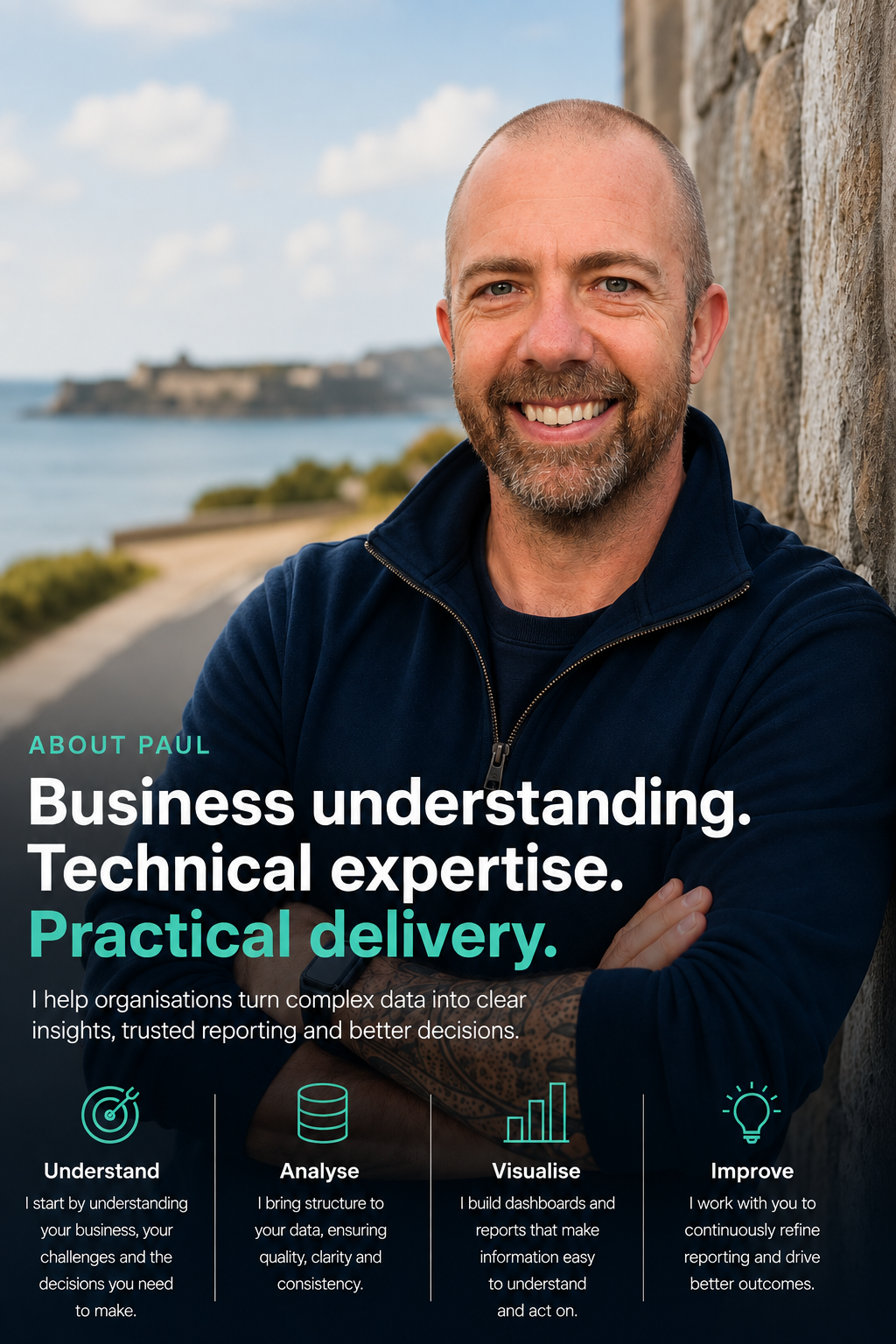
I work between the business and technical worlds.
I can sit with stakeholders, understand the problem in their language and then work directly with the data, systems and reporting to build something practical.
My experience spans healthcare, finance, regulatory reporting, operations, data quality, migration, business intelligence and project delivery.
That breadth matters because reporting problems are rarely only technical. They usually involve people, processes, definitions and decisions as well.
Why Make Sense Data
I have worked in very different organisations, but many of the reporting problems were remarkably similar.
Useful information existed, but people struggled to access it. Teams spent too much time preparing reports manually. Different departments worked from different versions of the same numbers.
Sometimes the problem was the data. Sometimes it was the process. Quite often it was simply that nobody had the time or capacity to step back, understand the whole picture and improve it.
There was room for a practical service that could understand the problem, find a sensible place to start and build something people would genuinely use.
That became Make Sense Data.
The difference
Data and reporting projects often sit between business teams and technical teams.
The people who understand the operational problem may not know how the underlying data is structured. The people who understand the systems may not have the context behind the business requirement.
I am comfortable working with both.
I can talk through the problem with finance, operations, compliance or senior management, then work directly with the data and technical detail needed to turn the requirement into something usable.
Good reporting starts with understanding the business, not opening the software.
A practical approach
I prefer to start with the real business problem, understand how things work today and agree a sensible first step before building anything.
I talk to the sponsor and the people doing the work, look at the current process and understand where the frustration, duplication or uncertainty is coming from.
The answer may involve better data or reporting, but it may also involve clearer ownership, simpler processes or better definitions.
I prefer a clear, practical starting point that solves a real problem rather than trying to design the perfect end state before anything has been delivered.
Reporting becomes better when the people who rely on it can use it, challenge it and help shape what comes next.
My experience
Working across different environments has made it easier to recognise recurring reporting and data problems and identify where a practical improvement can be made.
Working flexibly
Not every piece of work needs a large consultancy team or a permanent data specialist.
I can work directly with an organisation, alongside an existing internal team or as a specialist part of a wider consultancy project.
That might mean taking ownership of a Power BI or reporting workstream, helping untangle a difficult data problem or adding specialist capacity when an existing team is already stretched.
The important part is that the arrangement works for the people involved and the client gets the right support without making the project more complicated than it needs to be.
Running my own business
Alongside my data work, I run Trail Monkey , a Jersey trail running events business.
That gives me a useful perspective as a business owner as well as a consultant.
I use information to understand registrations, demand, capacity, event costs, marketing, pricing and longer-term growth. The decisions affect the health of the business, so the reporting needs to be straightforward and useful.
It has reinforced something I already believed from client work: reports are not valuable because they look impressive. They are valuable because somebody needs them to make a decision, save time or manage something better.
I am not building reports for the sake of building reports. I am building something somebody needs to use.
What success looks like
I do not measure success by how complicated the solution is. I measure it by what becomes easier for the people using it.
Reporting that previously required repeated spreadsheet work becomes more consistent and easier to produce.
People spend less time assembling reports and more time understanding what the information is telling them.
Teams can work from a shared view of the information and focus discussions on what is happening and what to do next.
The best outcome is something that becomes part of how the organisation works rather than a report that is forgotten after a few months.
Tell me what is taking too long, what is difficult to understand or what you would like to improve. I’ll give you a practical view of where I think I can help.